•  

US: Bright Fireball Streaks Across Skies of Washington and Oregon

A bright fireball streaked across the skies of Washington, Oregon, and Canada's British Columbia early on April 29, with the American Meteor Society receiving over 135 reports from witnesses across the Pacific Northwest.

  •  

China: “UFO” Over Heilongjiang Captured On Camera

This footage shows a blazing object streaking and breaking apart across the night sky over China's Heilongjiang Province on March 25. According to media reports, residents in several cities in the Heilongjiang Province including Yichun and Heihe witnessed the "UFO" at around 6:30 p.m. In an interview, the Astronomical Society of Heilongjiang Province said that the trajectory of the flying object is different to that of a meteorite or comet. The object might be a part of a man-made spacecraft that fell back to Earth after being affected by recent geomagnetic storms.

  •  
NASA’s Webb Finds Signs of Possible Aurorae on Isolated Brown Dwarf

NASA’s Webb Finds Signs of Possible Aurorae on Isolated Brown Dwarf

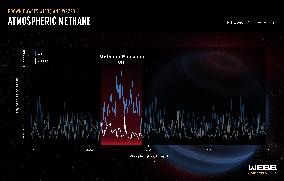
Handout photo - This artist concept portrays the brown dwarf W1935, which is located 47 light-years from Earth. Astronomers using NASA’s James Webb Space Telescope found infrared emission from methane coming from W1935. This is an unexpected discovery because the brown dwarf is cold and lacks a host star; therefore, there is no obvious source of energy to heat its upper atmosphere and make the methane glow. The team speculates that the methane emission may be due to processes generating aurorae, shown here in red. Infrared emission from methane suggests atmospheric heating by auroral processes. These findings are being presented at the 243rd meeting of the American Astronomical Society in New Orleans. To help explain the mystery of the infrared emission from methane, the team turned to our solar system. Methane in emission is a common feature in gas giants like Jupiter and Saturn. The upper-atmosphere heating that powers this emission is linked to aurorae. Photo by NASA, ESA, CSA, and L. Hustak (STScI) via AB

  •  
NASA’s Webb Finds Signs of Possible Aurorae on Isolated Brown Dwarf

NASA’s Webb Finds Signs of Possible Aurorae on Isolated Brown Dwarf

Handout photo - Astronomers used NASA’s James Webb Space Telescope to study 12 cold brown dwarfs. Two of them – W1935 and W2220 – appeared to be near twins of each other in composition, brightness, and temperature. However, W1935 showed emission from methane, as opposed to the anticipated absorption feature that was observed toward W2220. The team speculates that the methane emission may be due to processes generating aurorae. Astronomers using NASA’s James Webb Space Telescope found infrared emission from methane coming from W1935. This is an unexpected discovery because the brown dwarf is cold and lacks a host star; therefore, there is no obvious source of energy to heat its upper atmosphere and make the methane glow. The team speculates that the methane emission may be due to processes generating aurorae, shown here in red. Infrared emission from methane suggests atmospheric heating by auroral processes. These findings are being presented at the 243rd meeting of the American Astronomical Society in New Orl

  •  
SYRIA-DAMASCUS-CHILDREN-ASTRONOMY

SYRIA-DAMASCUS-CHILDREN-ASTRONOMY

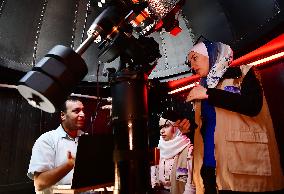
(221118) -- DAMASCUS, Nov. 18, 2022 (Xinhua) -- Muhammed Alassiry (L), the head of the Syrian Astronomical Society (SAS), explains as students learn to use a telescope at the SAS headquarters in Damascus, Syria, Oct. 10, 2022. TO GO WITH "Feature: U.S. sanctions dampen Syrian children's astronomy dream" (Photo by Ammar Safarjalani/Xinhua)

  •  
SYRIA-DAMASCUS-CHILDREN-ASTRONOMY

SYRIA-DAMASCUS-CHILDREN-ASTRONOMY

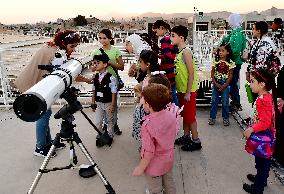
(221118) -- DAMASCUS, Nov. 18, 2022 (Xinhua) -- Children learn how to use a telescope at the Syrian Astronomical Society (SAS) headquarters in Damascus, Syria, Oct. 10, 2022. TO GO WITH "Feature: U.S. sanctions dampen Syrian children's astronomy dream" (Photo by Ammar Safarjalani/Xinhua)

  •  
SYRIA-DAMASCUS-CHILDREN-ASTRONOMY

SYRIA-DAMASCUS-CHILDREN-ASTRONOMY

(221118) -- DAMASCUS, Nov. 18, 2022 (Xinhua) -- Children learn how to use a telescope at the Syrian Astronomical Society (SAS) headquarters in Damascus, Syria, Oct. 10, 2022. TO GO WITH "Feature: U.S. sanctions dampen Syrian children's astronomy dream" (Photo by Ammar Safarjalani/Xinhua)

  •  
SYRIA-DAMASCUS-CHILDREN-ASTRONOMY

SYRIA-DAMASCUS-CHILDREN-ASTRONOMY

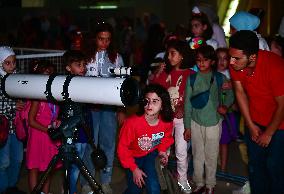
(221118) -- DAMASCUS, Nov. 18, 2022 (Xinhua) -- Children learn about planets and space at the Syrian Astronomical Society (SAS) headquarters in Damascus, Syria, Oct. 10, 2022. TO GO WITH "Feature: U.S. sanctions dampen Syrian children's astronomy dream" (Photo by Ammar Safarjalani/Xinhua)

  •  

Syrian space enthusiasts pursue dreams amid U.S. sanctions

STORY: Syrian space enthusiasts pursue dreams amid U.S. sanctions DATELINE: Nov. 10, 2022 LENGTH: 00:01:40 LOCATION: Damascus CATEGORY: SOCIETY SHOTLIST: 1. various of the activities on the roof of the Syrian Astronomical Society (SAS) headquarters 2. SOUNDBITE 1 (Arabic): TAREQ BURMO, Student 3. SOUNDBITE 2 (Arabic): MUHANNAD, Student 4. various of the activities on the roof of the Syrian Astronomical Society (SAS) headquarters 5. SOUNDBITE 3 (Arabic): MUHAMMED ALASSIRY, Head of the Syrian Astronomical Society STORYLINE: Persistent U.S. sanctions are affecting Syrians' life in an all-around way, including the space dream of the youth. On the roof of the Syrian Astronomical Society (SAS) headquarters in the capital Damascus, activities are organized almost every day for children who are interested in space. SOUNDBITE 1 (Arabic): TAREQ BURMO, Student "My dream is to become a doctor, but I also want to enter the field of astronomy. I aspire to be the first Syrian to travel and reach the moon." SOUNDBITE 2

  •  

Solar eclipse observed in Middle East

STORY: Solar eclipse observed in Middle East DATELINE: Oct. 26, 2022 LENGTH: 0:00:29 LOCATION: Damascus/Amman CATEGORY: ENVIRONMENT SHOTLIST: 1. various of solar eclipse STORYLINE: People in the Syrian capital of Damascus and the Jordanian capital of Amman observed a partial solar eclipse on Tuesday. The partial solar eclipse was visible from parts of Europe, northern Africa, the Middle East and many parts of western and central Asia. In Syria, people watched the eclipse with a special telescope or through the black polymer. But the sky above Damascus was cloudy and the eclipse couldn't be observed clearly. Meanwhile in Amman, Jordanian astronomy enthusiasts gathered at the Citadel archaeological site of Amman and across the kingdom to observe the partial solar eclipse. The Jordanian Astronomical Society organized the event to raise public interest in astronomy. A solar eclipse occurs on a new moon day when the moon comes in between the earth and the sun, and when all three heavenly bodies are aligned

  •  
Amateur astronomers flex their star gazing muscle

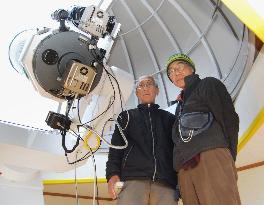
Amateur astronomers flex their star gazing muscle

SAGA, Japan - Koichi Nishiyama (R), 70, and Fujio Kabashima, 68, two Japanese amateur astronomers who have built their own observatory in Miyaki, Saga Prefecture, discovered six new stars last year and one in February. The pair, who posed for this photo in front of their telescope in January, will be commended by the Astronomical Society of Japan in March for their achievements. According to the National Astronomical Observatory of Japan, less than 20 new stars are discovered each year worldwide, and it is rare for two amateur astronomers to have discovered so many new stars. (Kyodo)

  •  
Prague city center without tourists, Astronomical Clocks, Old Town Square

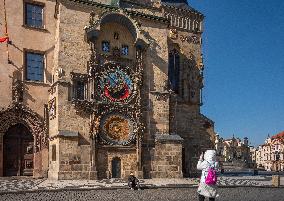
Prague city center without tourists, Astronomical Clocks, Old Town Square

Pandemia Coronavirus Covid influence tourism, in Prague, Czech Republic. Shops and restaurants are closed, people have to wear face masks. (CTK Photo/Martina Houdek)

  •  
Old Town Square, Old Town Hall, Astronomical clock, Empty center of Prague, historical center, Prague, city, without tourists, restricted movement of people, travel ban, prevention of infection, Coronavirus, Covid 19

Old Town Square, Old Town Hall, Astronomical clock, Empty center of Prague, historical center, Prague, city, without tourists, restricted movement of people, travel ban, prevention of infection, Coronavirus, Covid 19

Czech government restricted movement of persons throughout the Czech Republic because of pandemia Coronavirus - Covid-19. Shops and restaurants have been closed since 12 March 2020. Photo from Prague, Czech Republic. (CTK Photo/Martina Houdek)

  • Main
  • Top
  • Editorial
  • Creative
  • About Us
  • About ILG
  • Terms of use
  • Company
  • BEHIND
  • Price List
  • Single Plan
  • Monthly Plan
  • Services
  • Shooting
  • Rights Clearance
  • Support
  • FAQ
  • How To Buy
  • Contact Us
  • Become a Partner

© KYODO NEWS IMAGES INC

All Rights Reserved.

  • Editorial
  • Olympics
  • News
  • Sports
  • Japan
  • Tech
  • Royal
  • Disaster
  • NorthKorea
  • Old Japan
  • SNS
  • Creative
  • Food
  • Japan
  • Landscape
  • Animal
  • Popular
  • #Ukraine
  • #China
  • #coronavirus
  • #N. Korea
  • #Russia
  • #Thailand
  • #Ukraine
  • #China
  • #coronavirus
  • #N. Korea
  • #Russia
  • #Thailand
  • Food
  • Japan
  • Landscape
  • Animal
  • Olympics
  • News
  • Sports
  • Japan
  • Tech
  • Royal
  • Disaster
  • NorthKorea
  • Old Japan
  • SNS